Cambridge Study Reclassifies 324-Million-Year-Old Fossil as Earliest Insect
A specimen long cataloged as a crustacean at the San Diego Natural History Museum has been identified as an insect, closing a gap in the fossil record.
By Jonathan Fedorov ·
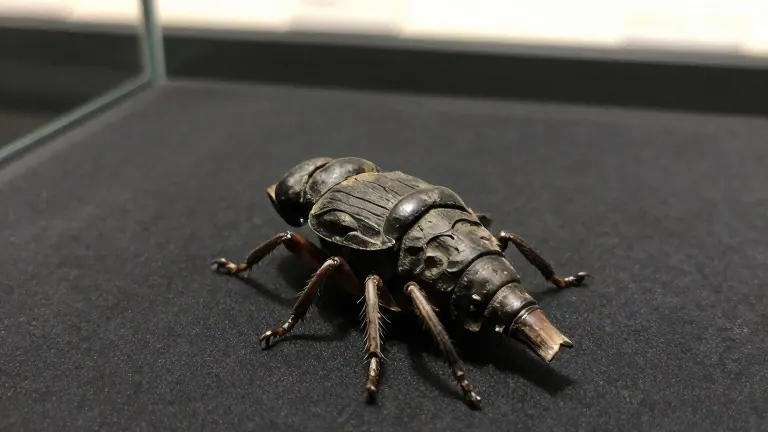
A 324 million-year-old specimen at the San Diego Natural History Museum has been reclassified from a crustacean to an insect, a change that alters the timeline of early terrestrial life. The fossil, cataloged as No. 28852, was previously identified as Tesnusocaris goldichi. A new label now designates it as Chosha praecursor, placing it at the younger boundary of the hexapod gap.
The hexapod gap is a 60 million-year span from 385 million to 325 million years ago, during which the fossil record lacked evidence of insect life. Some estimates place the end of this gap at 322 million years ago. By confirming the specimen as an insect, researchers have pushed the known date of insect existence back to 324 million years ago.
The reclassification followed a visit by Erik Thelka, a doctoral student at Cambridge University. Thelka examined the fossil under specially polarized light and identified features consistent with insects rather than crustaceans. He found an ovipositor, a tube-like structure for laying eggs, and a terminal filament, a thin tail-like extension from the abdomen.
While the specimen displays six legs on the thorax, a characteristic of insects, it also possesses additional pairs of paddle-like legs on the abdominal segments. These extra limbs are typical of crustaceans, which also have gills, twice as many antennae as insects, and branched legs. The Cambridge team posits that these extra legs were used for swimming, allowing the creature to move between land and water.
The discovery prompted researchers to re-examine other fossils, including one much older than the San Diego specimen. The team concluded that those fossils were also insects. Together, the specimens are described as the earliest uncontested insects on record.
The fossil entered the museum collection in 1985. Tom Deméré, curator of paleontology at the museum, was a curatorial assistant at the time. Frederick Schram, then curator of the collection, returned from a field expedition in Brewster County, Texas, where he had collected the specimen. Schram was a crustacean researcher who had written textbooks on the evolution of aquatic creatures.
Deméré noted that Schram traveled to Texas because the region had produced other interesting crustacean fossils. Although the distance between Texas and Southern California is considerable, Schram’s interest in global crustacean evolution drove the expedition. The fossil was not in total obscurity for the past four decades. A 1991 paper by Schram describing it as a novel crustacean led to its loan for examination to researchers in Eastern Europe and Germany.
Schram, who is now retired in Washington, did not respond to an email request regarding the classification change. Deméré stated that the recent attention was the result of quiet work by generations of scientists who unearthing, preserved, and held specimens. The museum collection includes artifacts gathered 100 or even 150 years ago.
Curators have installed the fossil in a glass enclosure on the museum’s lower level. The exhibit allows visitors to view the specimen’s swirled patterns and references the recent media coverage. Deméré said the discovery demonstrates that new findings can emerge from existing collections, allowing paleontologists to study the full history of life, extinction, and adaptation.
The reclassification highlights the importance of physical repositories in scientific research. By preserving specimens over long periods, museums enable researchers to examine the evolutionary history of life on Earth. The San Diego specimen, which sat in a drawer for decades, now serves as a key piece of evidence in understanding how crustaceans and insects diverged.
More Business · Rip-Off Report · Report a business · Got a Story?