Southwest Floods: 20 Trillion Gallons Fall as El Niño Peaks
Meteorologists report that a historically warm Pacific Ocean is fueling record rainfall across the Four Corners region and Nevada.
By Jonathan Fedorov ·
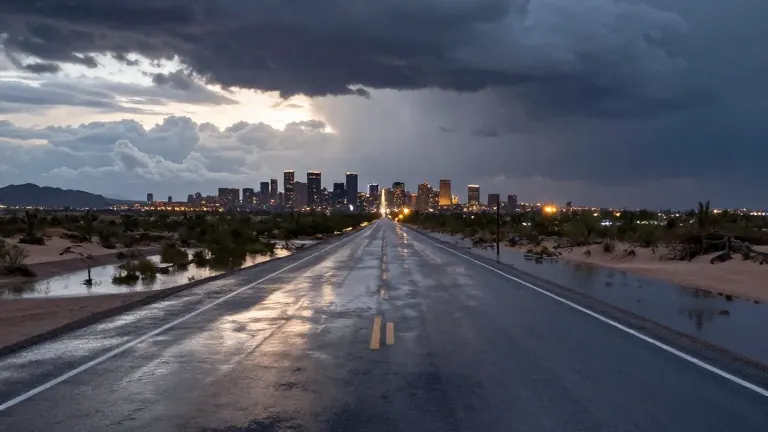
Over 20 trillion gallons of water have fallen on the Four Corners states and Nevada in the past two weeks, according to calculations by former National Oceanic and Atmospheric Administration chief scientist Ryan Maue. This volume of precipitation has driven severe flooding conditions across the region, a trend meteorologists attribute to a powerful warming cycle known as El Niño.
The current El Niño event is characterized by unusually warm Pacific Ocean waters that release moisture into the atmosphere. Meteorologist Jeff Masters of Yale Climate Connections described the phenomenon as a super duper El Niño, noting that while such events have occurred in the past, this iteration is particularly extreme. The system is expected to peak in December, with impacts potentially lasting for several more months.
Heavy rains on Sunday prompted evacuations in northern New Mexico and central Arizona. In Colorado, residents of a ski town prepared for their main river to reach catastrophic levels. These events followed a previous storm system that subjected southwestern states to days of flooding earlier in the month.
Climate scientist Daniel Swain of the University of California Agriculture and Natural Resources stated that the likelihood of heavy precipitation in the Southwest interior increases during this time of year. He added that the intensity of the current rainfall exceeds previous observations. The wet conditions are exacerbated by desert terrain, which absorbs water less effectively than other soil types.
Meteorologist Randy Cerveny of Arizona State University explained that global ocean temperatures are higher than they were 100 years ago due to human-caused climate change. This baseline warmth amplifies the intensity of El Niño situations. The shifting wind patterns associated with the phenomenon are redirecting strong air currents toward the Southwest, stirring up additional moisture.
The El Niño event is affecting weather patterns beyond the United States. Swain reported that Peru and Ecuador are experiencing record-breaking flooding, while parts of Southeast Asia, including Indonesia, are drier than usual. Park Williams of UC San Diego’s Scripps Institution of Oceanography noted in an email that the conditions are favorable for more heavy storms this winter and spring.
Cerveny stated that El Niño can provide benefits such as filling reservoirs in drier areas, though storms and floods remain dangerous to people and property. He emphasized that the Pacific Ocean has not yet reached its peak heating, indicating that more events of this nature are likely.