84% of High School Students Now Use AI for Schoolwork
New data reveals a sharp rise in AI reliance, prompting educators to rethink how schools motivate students to engage in challenging work.
By Jonathan Fedorov ·
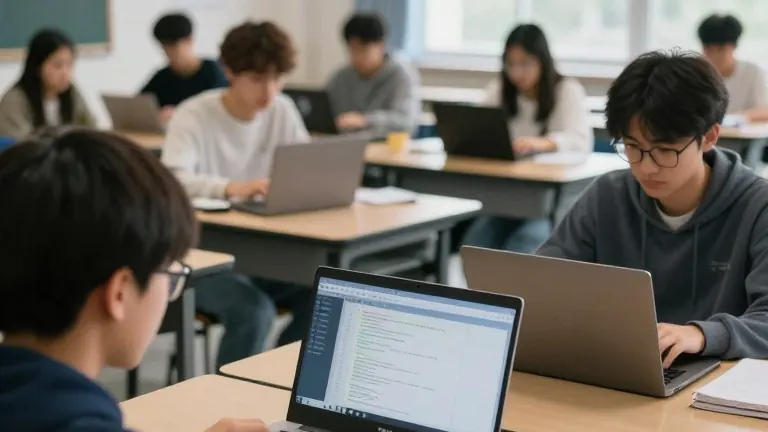
A College Board survey released last fall shows that 84% of high school students used AI for schoolwork between January and May 2025. This marks an increase from 79% in the same period the previous year. The data highlights a rapid shift in how students approach academic assignments.
Approximately half of these students used the technology for brainstorming, revising essays, or researching topics. A separate report from the University of Southern California found that most college students default to what researchers call executive help. They use AI to get fast answers with minimal effort rather than instrumental help that deepens understanding. Researchers noted that students tend to take the path of least resistance unless professors actively steer them otherwise.
Alex Campbell, a sociology teacher at Elizabethton High School in Tennessee, sees a different approach. In 2017, he challenged his students to solve the Redhead Murders, a series of cold cases that had stumped law enforcement for three decades. The students interviewed a victim’s brother, built timelines, and identified new victims. Their work became the basis for the 2024 podcast and subsequent Amazon Prime TV series Murder 101. Campbell said the project succeeded because students were invested in the hard work. He noted that meaningful experiences in life are almost always hard.
Educators argue that generative AI has exposed a long-standing problem of low student motivation. Chris Hulleman, a researcher at the University of Virginia, stated that schools have not done a good job making school interesting. He said the social contract has changed as students question why they should do boring work when a free tool can do it for them. Hulleman has studied student motivation for over 20 years and wrote his doctoral dissertation on the topic in 2007.
Rebecca Winthrop, a senior fellow at the Brookings Institution, said AI arrived at a time when the meaning of being well-educated is changing. She noted that the bar for higher-order thinking skills has shifted. A 2024 Gallup survey found that just 17% of middle and high school students strongly agreed they learned something interesting in the last seven days. Fewer than half said their coursework challenged them.
Dylan Kane, a Colorado math teacher, compared AI to indoor plumbing. He said it freed people from hauling water but erased the daily walking that kept them healthy. Kane warned that AI might be automating cognition faster than educators can find new ways to incentivize it. He suggested schools should focus on cognitive exercise, such as chess, robotics, or woodworking, to help students experience hard fun.
Eric Anderman, an educational psychologist at Ohio State University, said students typically split into two groups: those there to learn and those there to get grades. He noted that cheating rises when teachers emphasize tests and falls when the message shifts to learning. Anderman tells pre-service teachers that an A stands for artificial. He said educators need to do a better job of making the process meaningful.
Priten Soundar-Shah, author of Ethical Ed Tech, suggested teachers can use student skepticism to their advantage. He said if students scoff at foreign language instruction because of AI translation, ask them who they would rather rely on in Paris: a fluent speaker or someone waiting for their earbuds to process the conversation. Students often want to learn but worry about being the only one to refuse a shortcut.
More News · Campbell news · Report a business · Got a Story?